
Four ways to fill your schedule
Maximize your appointment slots: Strategies for success

The 2026 economic outlook for veterinary practices is concerning, with visits, client numbers, and revenue trending downward.1 Veterinary appointments reportedly declined by 2.8 per cent during the last 12 months.2
Because full schedules ensure healthy profits, experts advise aiming for an appointment fill rate of 85 per cent.3 Exceeding 90 per cent capacity could lead to less same-day appointment availability for sick patients, new clients being turned away, and increased risk of team burnout. Fill rates below 80 per cent will hurt profits and limit employee wages. To calculate your appointment fill rate, take the number of appointments seen divided by the number of available appointments.
If your appointment fill rate drops below 85 per cent, use these four strategies to fill empty slots:
1) Schedule progress exams at the end of visits
When acute issues, chronic diseases, or procedures require follow-up care, schedule progress exams as you wrap up each appointment. You will have more appointment availability and ensure timely care.
Say “progress exam” and never “recheck”
Clients may misinterpret “recheck” as optional and free care. The word “progress” shows you are moving forward in resolving the health concern and reiterates that follow-up care is medically necessary.
Book follow-up care in exam rooms
In dental practices, hygienists have greater success with pre-appointing patients than scheduling coordinators at checkout.4 By the time clients reach the checkout counter, they want to leave and may dismiss staff attempts to schedule. To improve compliance with follow-up care, have technicians book progress exams in exam rooms. If you don’t have computers in exam rooms and clients must schedule appointments at the front desk, put alerts in patient records so client service representatives (CSRs) know to schedule progress exams.
Lead clients to schedule
Pick the same weekday and time or use the yes-or-yes technique when booking follow-up care. Share benefit statements, such as getting the first appointment choice. Use the action word “needs” to indicate follow-up care is medically necessary instead of the wiggle word “recommend.” Book with the same veterinarian for exam efficiency and continuity of care.
Say, “Dr. <Name> needs to see <patient name> in 10 days for a progress exam for the ear infection. Does this same time on <date> fit your schedule?” Another opportunity is the yes-or-yes approach. Say, “Dr. <Name> has progress exams available on <date, time 1> or <date, time 2>. Which do you prefer?”
Contact clients who don’t book
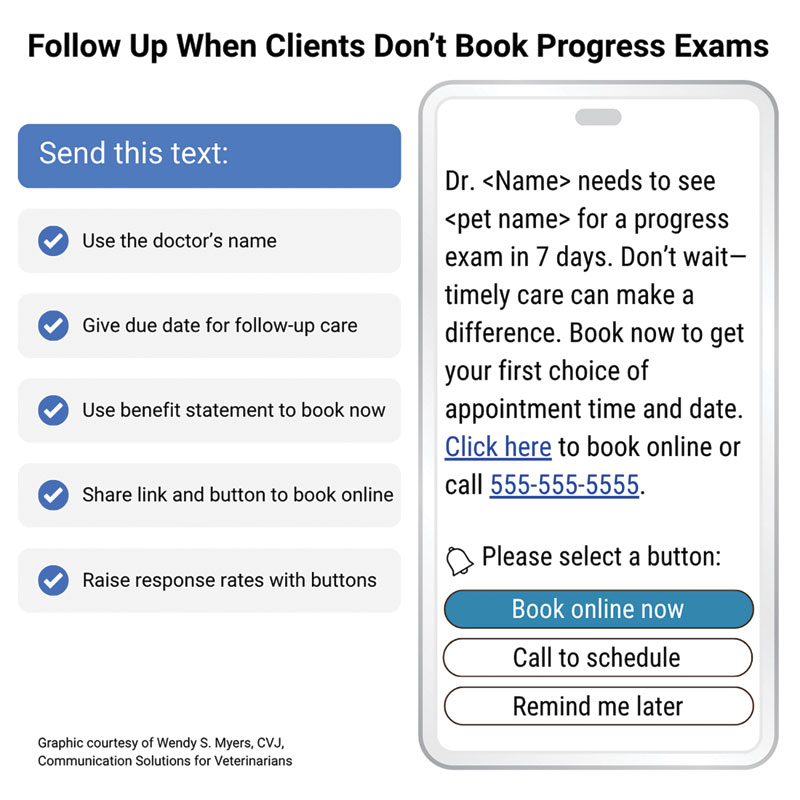
Enter a medical callback or automated text. In this ear infection scenario, call the client or send a text three days later, when seven days remain before follow-up care is due, to ensure appointment availability (Figure 1).
2) Offer online booking—especially for new clients
New clients account for eight per cent of practice revenue, but were reportedly down 8.6 per cent in 2024.5 Offering online scheduling is a key strategy to attract new clients. Veterinary practices’ utilization of online booking grew 87 per cent in 2025.6 New clients made 23 per cent of online appointment bookings, and 37 per cent of all online appointments were scheduled after business hours.
Millennials have digital-first preferences
As the largest segment of pet owners (33 per cent), millennials overwhelmingly prefer online scheduling and forms.7 As the first generation to grow up with the internet, they find digital tools more convenient and efficient than traditional methods like phone calls and paper forms.
Send confirmations with digital forms upon booking
Your client communications platform can automatically send text and email confirmations with new client forms. This lets you set up the medical record and request records from a previous veterinarian or adoption paperwork in advance.
Enjoy faster check-ins
New clients can share patient details, including breed, birthdate, vaccine status, reproductive status, and more, through online forms—avoiding paperwork that could take up to 15 minutes during the appointment.
3) Move patients up to fill openings
Shifting patients up in the schedule to fill empty slots is known as “schedule optimization.” This strategy improves efficiency, resulting in fewer schedule gaps and more consistent patient flow. A veterinarian saw an average of 15 patients per day in 2024.1 Let’s say the doctor has seven empty slots on Tuesday. Look for sick pet appointments on Wednesday and Thursday that could be rescheduled for Tuesday. This fills empty slots, prioritizes scheduling for ill patients, and enhances client satisfaction.
Keep a wait list of clients who want to be seen sooner. Fill cancellations or no-shows from your wait list. Text will be the fastest way to reach clients about newly available appointments.
4) Forward book wellness appointments
Wellness appointments account for 24 per cent of visits and are falling behind 2.9 per cent.9 When a client visits for a pet’s wellness appointment, book the next care six or 12 months in advance, filling your future schedule. An American Animal Hospital Association (AAHA) report found that increasing forward booking appointments from five per cent to 10 per cent could grow revenue by three per cent.10
Build your schedule 12 to 18 months out
Don’t worry if veterinarians’ schedules change. Doctors will request time off in advance for vacation and conferences, especially when booking travel. Simply contact clients with forward-booked appointments that need to be moved.
Pre-block wellness appointments
In my online course on Scheduling Mastery (https://csvets.info/SchedulingMastery), I teach how to pre-block four wellness appointments in each doctor’s daily schedule. These wellness appointments are strategically placed as the first appointment of the day, before lunch, after lunch, and the last appointment of the day. These wellness pre-blocks help keep your schedule on time and ensure your team goes home at closing time, reducing overtime and stress.
Lead clients to forward book
Say, “Just as your dentist has you schedule your next appointment at checkout, we do the same to proactively manage your pet’s health. By scheduling today, you will get your first choice of doctor, date, and time. Dr. <Name> can see your pet on <date, time 1> or <date, time 2>. Which do you prefer?”
Have your hospital manager track appointment fill rates monthly. Adjust the schedule to respond to trends, such as adding more urgent care pre-blocks during busy summer months. Knowing fill rates also lets you tweak staffing levels and identify whether it is time to hire another veterinarian to meet appointment demands.
Wendy S. Myers, CVJ, trains veterinary teams to communicate with clarity and confidence, inspiring client trust and better medical care. Founder of Communication Solutions for Veterinarians, she teaches proven skills through online courses, conferences, and consulting. Myers’ experience as a partner in a specialty and emergency hospital gives her insight into practice challenges. Explore her online training at CsvetsCourses.com.
References
View references for this article at veterinarypracticenews.ca/4-ways-to-fill-your-schedule.

Sign up for our newsletter
Get all the latest news and features from Veterinary Practice News Canada. Submit your email below to get our twice-monthly newsletter.
Popular Articles
-
1
-
2
-
3
-
4
-
5
Read the Latest Issue

