
Conquer compassion fatigue once and for all
Emotional therapies and support may help, but not actually fix what is broken
 Numerous articles have been written on compassion fatigue in the veterinary field, often including a range of supportive therapies from getting more rest and exercise to joining support groups. It inevitably harshly impacts caring, empathic professionals like you who work in an environment of daily traumatic stress.
Even Mother Teresa understood the personal toll that caring for others takes on one’s mind and body—she insisted that nuns take a year off from their care-giving duties every four to five years in order to heal.
In the absence of the luxury of taking time off to recover, what really can be done to address compassion fatigue once and for all? And what will it take to actually conquer this epidemic versus just accepting it as part of the profession and learning to cope with it when it hits you? I’ll give you a hint: Talking with supportive friends and thinking more positively isn’t going to cut it. Not when there are most likely overlooked physical and physiological breakdowns in your body stemming from the incredible impact the emotional, moral, and physical stress your job has on you each day. And that’s not even including the more traditional stressors of your personal life! Emotional therapies and support may help manage this stress, but what about fixing what may actually be broken?
“Stress is caused by giving a crap”
The toned-down version of this quote doesn’t lessen the burden of chronic stress on our bodies. From typical emotional strain and daily professional demands to lesser-known stressors like caffeine, processed foods, lack of quality sleep, prescription medication, food sensitivities and allergies, and ongoing (and possibly hidden) infections, stress plays havoc with your mind and body, leading to everything from mood disorders, sleep disturbances, and fatigue to weight gain, digestive issues, ongoing sickness, and chronic pain—all common symptoms tied to compassion fatigue.
 Holding stress accountable is nothing new, but to truly understand the full potential impact of ongoing strain and tension, one first must understand the central stress response system, the hypothalamic pituitary adrenal (HPA) axis. In response to any form of stressor, whether it is emotional, physical, physiological, or environmental, cortisol is released for several hours via triggers within the HPA axis, helping our bodies adapt to the situation. Problems arise when ongoing stress causes the HPA axis to desensitize and the glands to become overworked and out of sync, mostly from having to continuously produce this required cortisol.
Let’s look at some key physical and mental effects of chronically high cortisol levels, and the potential outcomes and consequences you might face—or be facing right now.
Blood sugar dysregulation
In its natural response to stress of any form, elevated cortisol causes continuous insulin release from your pancreas, repeatedly flooding your bloodstream with glucose. As this process becomes chronic, it becomes difficult to manage, eventually leading to insulin resistance. This in turn leads to sugar cravings and constant hunger, fatigue after eating (and energy fluctuations in general), a sluggish thyroid, inability to maintain or lose weight, infertility, headaches, impaired memory, overall irritability, skin conditions, and poor sleep. Blood sugar regulation is one of the most critical foundations of good physical and mental health, yet between the combination of ongoing cortisol output to handle repeated stress and the increased insulin that results, it’s a difficult goal to achieve without the right diet and lifestyle approach.
Hormonal imbalances
As a “major” hormone in the body, all that excess insulin makes it very difficult for the body to properly manage “minor” hormones like estrogen, progesterone, and testosterone. Further, ongoing stress depletes our adrenal (or “stress”) glands, which contribute to important hormone production in both men and women.
Hormones are the lenses we see life through each day that greatly impact our moods and sleep quality. In fact, imbalanced hormone levels single-handedly contribute to a significant portion of compassion fatigue symptoms, including depression, anxiety, irritability, withdrawal, apathy and low overall motivation, sleep issues, cravings, weight gain, low libido, and for women specifically, menstrual cycle irregularities. But how many of you suffering from some of these effects have had your hormone ratios checked recently?
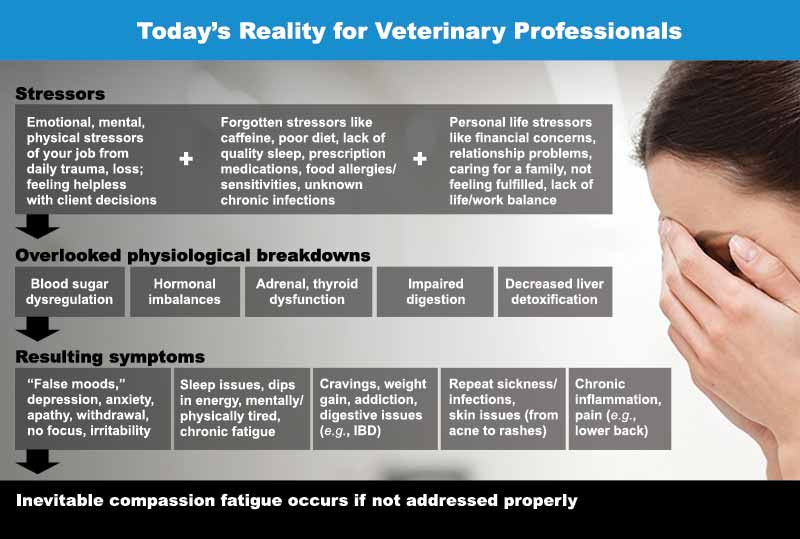
Adrenal gland, thyroid dysfunction
As our “stress glands” are paired with environments of repeated stress and trauma, our adrenals become depleted from their constant cortisol output to help the body manage real and perceived threats. They almost always require repair and support in order to boost energy and mood, reduce sensitivity to all forms of stress, improve sleep quality, adjust hormonal imbalances, stabilize blood sugar levels, strengthen immunity, calm inflammation and chronic pain, repair eczema and other skin conditions, boost tissue and body rebuilding, and fight ageing overall.
Tired adrenals make life harder than it really is. They also lead to low thyroid function, as it’s almost impossible to have a strong thyroid with weak adrenals. Plus, cortisol has an indirect dampening effect on hormonal output—including the thyroid’s free T3 and T4 hormones—as it tells the hypothalamus to down-regulate. That means slowed metabolism, fatigue, weight gain, thinning hair, pale skin, cold intolerance, muscle aches, and more.
Slowed or impaired digestion
Your digestive function takes a major hit in the midst of stress and is impacted anywhere along the digestive tract as the body switches to (and often stays in) a sympathetic state versus a calm, “rest and digest” parasympathetic one. By going into a stressed sympathetic mode, the body shifts energy resources to fighting off the perceived threat versus supporting functions the body considers non-essential at the time (like digestion).
This causes everything from nutrient absorption issues, “leaky gut,” immune system confusion, weight gain, constipation, irritable bowel, and other uncomfortable symptoms to reduced stomach acid negatively impacting critical protein digestion. You could be eating all the protein in the world, but if you’re not breaking it down and digesting it properly, you’re limiting your body’s ability to build muscles, nerves, enzymes, antibodies, and hormones. You will also lack the critical amino acids that are required for proper neurotransmitter function affecting your moods, memory, motivation, energy, libido, sleep quality, and potential for addiction to coffee, chocolate, nicotine, or worse. In fact, you’ll start to experience “false moods” that stem from the brain’s lack of “good mood” chemicals—a critical piece of the compassion fatigue puzzle.
Decreased liver detoxification
Cortisol also impairs liver function, and as the true workhorse of the body responsible for more than 500 functions, you can see how this can cause a range of problems. Most notably tied to compassion fatigue, limited detoxification function can result in toxin and hormone buildup (creating those imbalances we don’t want), low energy, negative thinking, anxiety and depression, chronic pain, allergies, skin problems, weight gain, and various digestive issues from bloating to constipation or diarrhea.
Improving on solutions that fall short
 Do any of these health conditions sound familiar? The worst part is eventually the cortisol output “runs out” due to those adrenal glands tiring from constant secretion, triggering or compounding these health issues. High and low cortisol states actually produce very similar symptoms, making them tricky to decipher, but the key is cortisol balance and proper HPA axis regulation (and ensuring something as simple as getting enough water and healthy fats each day).
Ongoing stress of any kind means not only mental strain and fatigue but also actual breakdowns in your body that can contribute significantly to the collection of symptoms known as compassion fatigue. This is where today’s self-help therapies fall short. They can help with the mental aspects and how to cope with these symptoms, but if the overlooked underlying physical and physiological issues aren’t properly identified and addressed, there’s no chance of conquering this destructive state.
So where do you start and what do you do differently? Here’s a simple four-step approach (alongside more traditional supportive therapies) I call HEAL:
Help. Acknowledge that you need assistance and that you’re ready to really dig deep and review your symptoms to better understand what your body is trying to tell you.
Expose the dysfunction. Work with the right health practitioner to review your full range of symptoms and run the right tests to get the answers you need. For example, standard testing should include at least a comprehensive GI stool test to ensure proper function throughout your entire digestive tract, the right food sensitivity panel to identify your most impactful food-based “triggers” that can cause a host of physical and mental health problems, and, if initial symptoms are indicative of some level of dysfunction, an adrenal and sex hormone panel to confirm gland health and hormone level output.
Address the dysfunction. With the data, aggressively target any dysfunction, usually with natural supplements and dietary changes that are right specifically for you, as the combination of function and fuel leads to health optimization. For example, low stomach acid can be addressed easily through proper hydrochloric acid supplementation, exhausted adrenal glands can be boosted and supported with everything from glandulars and protomorphogens to herbal adaptogens and the right multivitamin, and sadness and anxiety can be addressed quickly through amino acid supplementation. The key is knowing what needs fixing and then choosing the attack plan that’s right for you.
Lift overall strength and resilience. Last, your job isn’t suddenly going to be void of daily trauma and stress, so you need a boost for the future in order to prevent additional setbacks and to help you love life and work again. This usually involves longer-term, maintenance-type supplements, such as ongoing adrenal/stress management support, simple diet tricks like balancing blood sugar, and really focusing on healthy fats to ensure maximum hormone and brain function plus sustained energy, mood, and weight management. It’s about having a plan of attack going forward so you can thrive at your job again and make compassion fatigue a thing of the past.
There is no question that the veterinary industry offers many opportunities for one to become overwhelmed, disenfranchised, or demotivated. That said, compassion fatigue doesn’t have to be a reality for you or anybody in your clinic if dealt with properly. That means definitely incorporate some of the more traditional supportive therapies like meditation and exercise, but don’t forget to “look under the hood” to see if something may be temporarily failing, preventing you from conquering compassion fatigue once and for all.
Kirstin Gulbransen is the founder of All Beings Nutritional Therapy, a practice focused on helping people and pets achieve optimal health through nutrition. She’s a certified nutritional therapist and restorative wellness practitioner with a special interest in the veterinary community. E-mail her at kirstin@allbeingsnutrition.com.

Sign up for our newsletter
Get all the latest news and features from Veterinary Practice News Canada. Submit your email below to get our twice-monthly newsletter.
Popular Articles
-
1
-
2
-
3
-
4
-
5
Read the Latest Issue

