Navigating the BOAS crisis with CO2 laser surgery
Veterinary practices are now responding to the crisis—a crisis of breathlessness
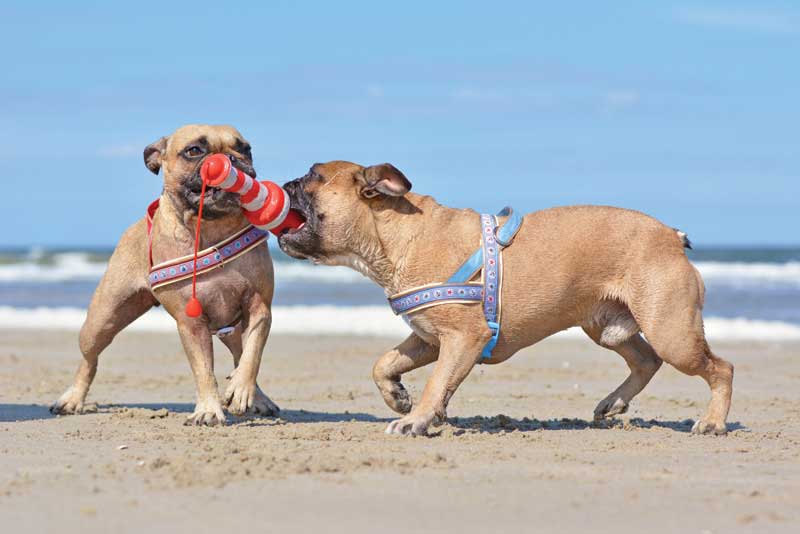
Brachycephalic dog breeds have increased in popularity over the last 15 years while suffering from multiple well-documented health problems. Increasing numbers of dogs are selectively bred for shorter noses, wider faces, and predisposition to brachycephalic obstructive airway syndrome (BOAS). Registrations of brachycephalic breeds continue to increase in Canadian and American Kennel Clubs despite increased health risks.1-3
Veterinary practices are now responding to the crisis—a crisis of breathlessness. We now better understand the multiple morbidities that accompany selection for brachycephaly, and how the anatomical abnormalities lead to progressive airway obstruction. We know that early intervention to correct airway obstruction is essential.4 General practices are intervening early, using CO2 surgical lasers to correct stenotic nares and elongation of the soft palate, giving brachy patients a breath of fresh air and improved quality of life.
A progressive disease
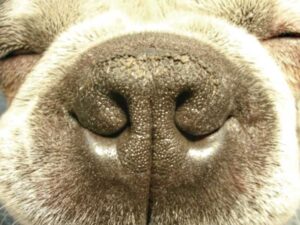
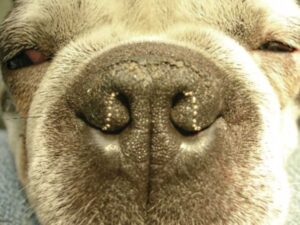
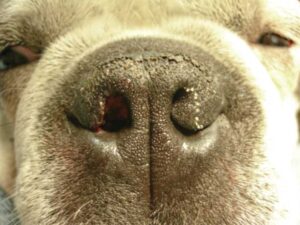
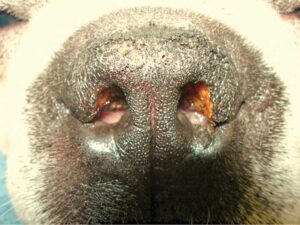
Brachycephalic conformation includes multiple anatomical abnormalities. Stenotic nares, aberrant turbinates, elongation of the soft palate, and tracheal hypoplasia are the physical abnormalities restricting airflow. Greater pressures are required during breathing, particularly during inspiration. Over time, increased negative pressure in the airways results in secondary changes, including pharyngeal hyperplasia, eversion of the laryngeal saccules, hyperplasia of the tonsils, and laryngeal and bronchial collapse.5-8
As changes compound, BOAS symptoms become more evident. The charming, gentle snoring of the brachycephalic dog is replaced by gagging, regurgitation, stridor, reduced exercise tolerance, and dyspnea. Increased incidence of gastrointestinal disease and episodes of hyperthermia and syncope may be seen in later stages.9-14
Since BOAS is a progressive syndrome—with secondary pathologies following inherited anatomical abnormalities—if untreated, the prognosis becomes worse. Historically, general practitioners have not performed surgeries to correct the anatomical abnormalities, considering the procedure is difficult and high risk. Severely affected patients were referred to surgeons after BOAS had significantly hindered quality of life. That has changed. Today, primary-care veterinarians, in general practice, can intervene surgically to address the primary anatomical abnormalities of stenotic nares and elongated soft palate.
BOAS procedures
Using a CO2 laser to resect the soft palate was first described in 1994, representing a new option for surgical treatment of palate elongation in dogs.15 The technique was rapid and uncomplicated with good hemostasis. Evaluation of CO2 laser versus conventional incisional techniques for resection of soft palates showed similar clinical outcomes—with the advantage of the laser resection’s simplicity and reduced surgical time.16
The continued development of laser techniques for soft palate resection, accompanied by the increased use of surgical lasers by general practitioners, facilitated earlier and more frequent surgical intervention for BOAS. General practitioners using CO2 lasers learned palate resection and stenotic nares correction are procedures they can perform with confidence and good prognosis.
When general practitioners became proficient and confident with BOAS procedures, early intervention became widespread. While the knowledge that early intervention is the best way to prevent BOAS complications was already well established,
the CO2 laser made application of that knowledge possible
for nonspecialists.17-19
Young patients with severe nares stenosis are candidates for surgery as early as three to four months old. Less severe patients should have the stenosis corrected by six months of age. Regardless of the age of stenosis repair, the palate should be evaluated, and elongation corrected at the same time.
New concepts for BOAS CO2 laser surgery
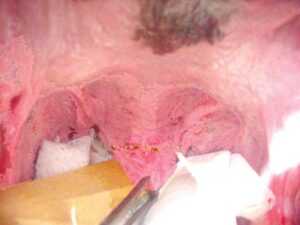
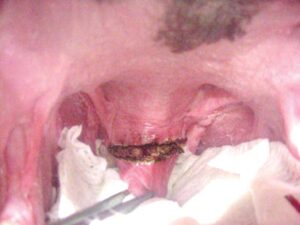
Using a CO2 laser to correct the respiratory defects of brachycephalic dogs is straightforward: perform the conventional surgical procedures while substituting the laser for scalpel and scissors when cutting affected tissue. The techniques for this simple transition to using the laser with both stenotic nares and elongated soft palate corrections have been widely published with pictorial instructions.20-23
Today’s CO2 surgical lasers are more powerful, have more sophisticated settings, and are equipped with more efficient and ergonomic delivery systems. Understanding how to combine multiple laser parameters to achieve the best tissue effect is critical to maximizing BOAS surgical outcomes. Just as with conventional BOAS surgeries, cutting with a sharp “laser knife” is indicated. Current protocols include use of higher-power levels and a small spot size. The use of pulsed delivery facilitates nontraumatic marking of tissue prior to incision. Superpulsed delivery during incision helps reduce thermal damage to the tissue left behind.24
- Stenotic nares repair: The advantages of using the CO2 laser in this surgery are minimal hemorrhage and excellent visualization, allowing bilaterally symmetrical removal of tissue and enhanced postoperative cosmesis. The portion of the alar fold obstructing the medial meatus is removed on each side by laser excision and ablation. The procedure requires no sutures; healing is by second intention.20
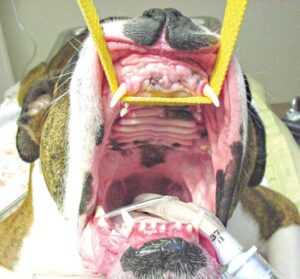
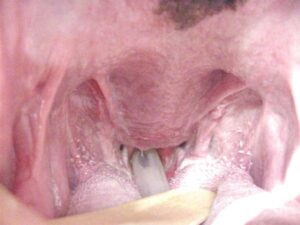
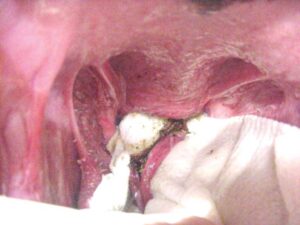
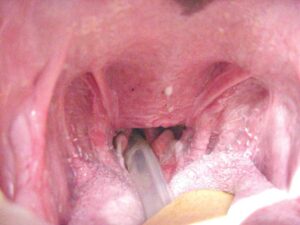
- Soft palate resection: Determining the amount of tissue to excise is critical to successful soft palate resection. Prospective BOAS surgeons must become familiar with normal pharyngeal anatomy to assess what is abnormal. In normal dogs, the tip of the epiglottis brushes the caudal border of the soft palate on inspiration and expiration. A light articulation of the epiglottis and soft palate is the goal when resecting redundant soft palate in BOAS dogs. Another important anatomical landmark is an imaginary line between the caudal poles of the tonsils, any soft palate that extends caudal to that line is redundant.25
With the patient in ventral recumbency and the mouth secured open, the initial step in soft palate resection is marking the line of excision. This is easily accomplished by briefly removing the endotracheal tube, pulling the epiglottis rostrally so it lies on the soft palate, and then using the laser in a pulsed mode to mark the outline of the epiglottis. If the soft palate is resected along the marked line, the epiglottis and soft palate will have an anatomically correct articulation. An initial partial thickness incision along the marked line is followed by complete resection from each lateral side to the midline. In most patients there is no hemorrhage and sutures are not required. 20
We are all part of the BOAS crisis
The growing popularity of brachycephalic dog breeds is an animal welfare challenge, one that we created. Studies show the distinctive physical appearance of brachycephalic dog faces are part of our initial attraction to them. Their large eyes and foreheads, as well as wide cheeks, evoke human responses like the infantile facial stimuli human babies evoke. Their baby-like facial features encourage positive emotions and nurturing responses in us.26, 27 We are instinctively attracted to them by their cuteness. The cuter the breed, the more popular it becomes. The more popular the breed becomes, the more breeders select for traits that make the breed popular.
Unfortunately, a common psychological component of brachycephalic ownership is a dissonance in owners’ perception of their dogs’ health. Owners often do not recognize symptoms associated with BOAS or they assume the symptoms are normal for the breed. Symptoms are commonly ignored until after airway obstruction results in secondary anatomical and physiological changes.28
We are the solution
Historically, veterinarians have assumed a passive role in the welfare challenge presented by brachycephalic conformation. Not addressing the predisposition for BOAS with owners and breeders contributes to the problem, as does failing to educate owners about symptoms and disease progression. Veterinarians have the opportunity and responsibility to advise clients and breeders about breed-related health and welfare issues. Clients and breeders need patiently repeated, evidence-based information, provided in sensitive and open communication.29
Veterinarians must also seize the initiative to influence association and public policy to help breed standards evolve to more normal conformation through official veterinary association position statements. Association members can initiate, help develop, and disseminate responsible position statements. They can lobby for strengthened animal welfare legislation.
Reversing centuries of phenotype selection for brachycephaly cannot be accomplished quickly. Centuries of breeding selection may even be irreversible in some brachycephalic breeds.4 Regardless, all of us have a professional and moral responsibility to help our patients in crisis while joining the effort to help diminish the crisis for brachycephalic breeds.
John C. Godbold, Jr., DVM, practised as a solo companion animal practitioner for 33 years. Dr. Godbold now works with Stonehaven Veterinary Consulting, generating and delivering educational content for colleagues and assisting equipment manufacturers with the development of new laser and light-based technologies. In high demand as a continuing education speaker, Godbold has led more than 900 laser workshops, wet labs, and continuing education meetings throughout North America and more than 25 other countries.
References
- Online (2023) https://www.ckc.ca/en/News/2023/March/2022%E2%80%99s-Top-10-Most-Popular-Dog-Breeds
- Online (2023) https://www.cnn.com/2023/03/15/us/french-bulldogs-popularity-akc-cec/index.html
- Online (2023) https://news.nationwide.com/brachycephalic-breeds-analysis-face-increased-health-risks/
- Fawcett, A. et al. (2018) Consequences and Management of Canine Brachycephaly in Veterinary Practice: Perspectives from Australian Veterinarians and Veterinary Specialists. Animals. 9(1):pii: E3.
- Ladlow, J. et al (2018) Brachycephalic obstructive airway syndrome. Vet. Rec. 182:375–378.
- Ekenstedt KJ, Crosse KR, Risselada M. (2020) Canine Brachycephaly: Anatomy, Pathology, Genetics and Welfare. J Comp Pathol. 176:109-115.
- Krainer D, Dupré G. (2022) Brachycephalic Obstructive Airway Syndrome. Vet Clin North Am Small Anim Pract. 52(3):749-780.
- Mitze, S. et. al. (2022) Brachycephalic obstructive airway syndrome: much more than a surgical problem. Vet Q. 42(1):213-223.
- Trappler, M. & Moore, K. (2011) Canine brachycephalic airway syndrome: pathophysiology, diagnosis, and nonsurgical management. Compend Contin Educ Vet. 33(5):E1-4.
- Yoon, H. et al. (2020) CT and radiographic evaluation of bronchial collapsibility at forced expiration in asymptomatic brachycephalic dogs. Vet Radiol Ultrasound. 61(2):167-180
- Hara, Y. et al. (2020) Pharyngeal contraction secondary to its collapse in dogs with brachycephalic airway syndrome. J Vet Med Sci. 82(1):64-67.
- Poncet, C.M. et al. (2005) Prevalence of gastrointestinal tract lesions in 73 brachycephalic dogs with upper respiratory syndrome. J. Small Anim. Pract. 46:273-279.
- Kaye, BM. et al. (2018) Relationship between brachycephalic airway syndrome and gastrointestinal signs in three breeds of dog. J Small Anim Pract. 59(11):670-673.
- Davis, MS. et al. (2017) Effect of brachycephaly and body condition score on respiratory thermoregulation of healthy dogs. J. Am. Vet. Med. Assoc. 251(10):1160-1165.
- Clark, GN. and Sinibaldi, KR. Use of a carbon dioxide laser for treatment of elongated soft palate in dogs. J Am Vet Med Assoc. 1994; 204(11):1779-1781.
- Davidson, EB. et al. (2001) Evaluation of carbon dioxide laser and conventional incisional techniques for resection of soft palates in brachycephalic dogs. J Am Vet Med Assoc. 219(6):776-781.
- Hendricks, JC. (1992) Brachycephalic airway syndrome. Vet Clin North Am Small Anim Pract. 22(5):1145-1153.
- Helund, CS. (1998) Brachycephalic Syndrome. Current Techniques in Small Animal Surgery, 4th ed.. (ed. Bojrab, MJ.) Williams & Wilkins. 357-362.
- Helund, C.S. (2002) Stenotic Nares. Small Animal Surgery, 2nd ed. (ed. Fossum, TW.) Mosby. 727-730.
- Arza, RA. (2019) Laser Surgery Procedures of the Nose and Throat. Laser Surgery in Veterinary Medicine. (ed Winkler, CJ.) Wiley. 99-105.
- Core, DM. (2013) CO2 laser allows bloodless repair of stenotic nares. Veterinary Practice News. October 2013: 32-33.
- Kudła, Z. and Nikolajdu-Kudła, A. (2019) Brachycephalic obstructive airway syndrome (BOAS) in dogs–Part 1: Stenotic nares repair with a CO2 laser . Veterinary Practice News. May: 40-41.
- Kudła, Z. and Nikolajdu-Kudła, A. (2020) Brachycephalic obstructive airway syndrome (BOAS) in dogs–Part 2: Elongated soft palate resection with a CO2 laser . Veterinary Practice News. February 2020; pp 40-41.
- Godbold, JC. Surgical Laser Basics: 5 Tips for the Novice User. Clinician’s Brief. http://www.cliniciansbrief.com/article/surgical-laser-basics-5-tips-novice-user. 2015. Accessed January 20, 2024.
- Riecks, TW. et al. (2007) Surgical correction of brachycephalic syndrome in dogs: 62 cases (1991-2004). J Am Vet Med Assoc. 230(9):1324-1328.
- Lorenz, K. (1971 Part and parcel in animal and human societies (1950) A methodological discussion. Harvard University Press.
- Archer, J. and Monton, S. (2010). Preferences for Infant Facial Features in Pet Dogs and Cats. Ethology. 117:217-226.
- Packer, RMA. et al. (2019) Great Expectations, Inconvenient Truths, and the Paradoxes of the Dog-Owner Relationship for Owners of Brachycephalic Dogs. PLoS ONE 14(7):e0219918.
- Kenny DD, Freemantle R, Jeffery A, Tivers MS. (2022) Impact of an educational intervention on public perception of brachycephalic obstructive airway syndrome in brachycephalic dogs. Vet Rec.190(11):e1430.

Sign up for our newsletter
Get all the latest news and features from Veterinary Practice News Canada. Submit your email below to get our twice-monthly newsletter.
Popular Articles
-
1
-
2
-
3
-
4
-
5
Read the Latest Issue

