
Working together supports rehab care
While Canadian pet owners are keen to seek out integrative care options for their animals, the scope remains limited
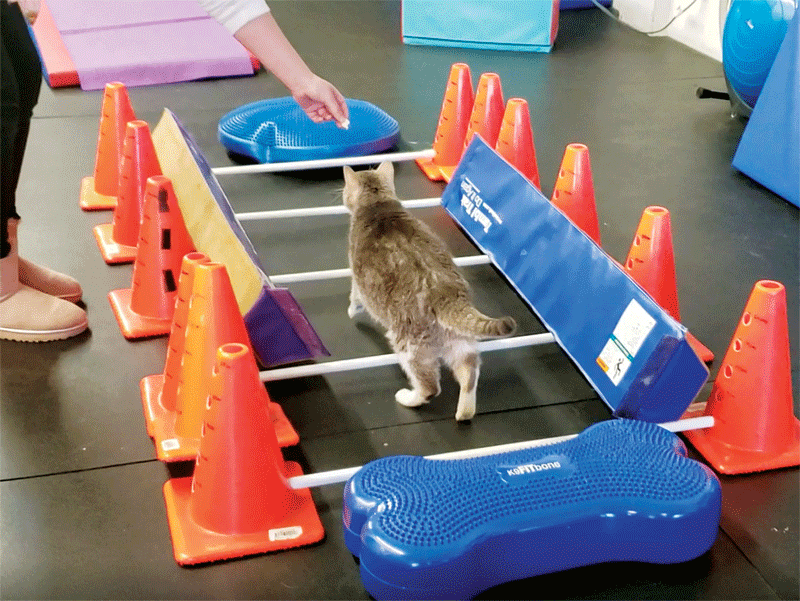
Photo courtesy SOAR
While veterinarians regularly collaborate with other animal healthcare professionals, patient referrals to practitioners outside of the veterinary industry is far less common. By comparison, in the human medical system, inter-professional collaboration is much more established. Additionally, the public has direct access to certain human healthcare professionals, such as chiropractors and physiotherapists.
This difference in approach can be attributed to a number of factors. Namely, practitioners in the human health field have years of experience, education, and training within their field, and are strictly regulated by their respective colleges when working on human patients. In contrast, regulatory oversight is variable within the field of animal rehabilitation. Further, veterinary rehab certification programs, while intensive, are not all inclusive. They provide a good addition to the knowledge base of each professional taking the course.
Nonetheless, the number of available rehabilitation courses that certify animal physiotherapists, chiropractors, veterinary technicians, and veterinarians is increasing. Most of these programs involve many hours of online didactic information, combined with in-person/hands-on training, mandatory hours under a certified practitioner, and, finally, both written and practical examinations.
Unfortunately, however, there remains a wide variation in regulation and scope of practice—not only within Canada, but worldwide. Questions often arise, such as:
- How does a veterinarian refer to a non-veterinarian?
- Who is liable should something go wrong?
- Should referrals be mandatory?
- How can a veterinarian know if a professional is certified in rehabilitation or chiropractic?
Indeed, while more and more Canadian pet owners are keen to seek out alternative and integrative care options for their animals, the scope remains limited—largely because of challenges which exist higher in the chain. In Ontario, for example, the provincial Veterinarians Act has not been updated since 1989. As such, many practices and recommendations outlined in the document (particularly as they relate to animal rehabilitation) are largely out of date.
Given this hurdle, the College of Veterinarians of Ontario (CVO) recognizes some changes are in order and has set wheels in motion to improve patient care from the ground level.
Change in action
While updating the Veterinarians Act is, understandably, a significant undertaking, steps have been taken to provide guidance to both the public and veterinarians on how inter-professional collaboration and referral in rehabilitation can safely be achieved.
Development of the path forward has involved multiple voices from a variety of interested partners. Namely, Policy and Position Statements were developed specifically on the Use of Forms of Energy in the Treatment and/or Care of Animals.1,2 With CVO only able to govern veterinarians and veterinary medicine, these documents categorized uses of forms of energy and their associated risk into high, moderate, and lower and provided examples of each.
Examples of animal rehabilitation modalities included in this risk assessment are:
- Class 4 versus Class 3 lasers;
- radial versus focal shockwave;
- ultrasound; and
- transcutaneous electrical neurostimulation.
The documents also detail the degree of supervision required for each level of risk, including indirect, direct, none required, or use by a veterinarian only.
The right panel

Infographics courtesy SOAR
Another focus of CVO was to form a working group, comprised of two veterinarians, two registered veterinary technicians (RVTs), two physiotherapists, and two chiropractors.
The goals of this group were to:
1) Identify resources that may be developed to support the education of veterinarians on the defined roles and expertise of non-veterinarian professionals as animal rehabilitation providers, as well as relevant treatment options.
2) Recommend a referral process that supports veterinarians and clients in assuring access to safe rehabilitation treatments by non-veterinarian professionals.
3) Explore the pros, cons, and various methods of rostering trained non-veterinarian professionals to facilitate referral and access in the promotion of inter-professional collaboration.
While the struggles to promote inter-professional collaboration in rehabilitation in a safe manner are well known by those practicing it, the general public and many veterinarians are not aware of the challenges and changes occurring. As such, the working group’s next steps were to help guide the public to safe choices and provide guidance for veterinarians needing to refer patients to qualified, non-veterinary animal care providers.
Specifically, the goals were to:
1) Develop a joint message for circulation amongst the professions focused on the promotion of safe collaborative care in animal rehabilitation, including messaging related to how to confidently identify qualified caregivers.
2) Develop a position statement from CVO’s council on the importance of collaborative care in animal rehabilitation and of balancing public choice and ensuring safe animal outcomes.
3) Ensure the college’s public register is easily searchable related to identifying veterinarians practicing in animal rehabilitation and their associated location and services.
4) Develop and promote online rosters for qualified non-veterinary rehabilitation professionals to help facilitate collaborative care.
5) Encourage the creation and/or refreshment of statements on expected standards for non-veterinarian professionals practicing in animal rehabilitation to ensure suitable education and distribution for all providers and the public.
6) Create and promote education materials related to the differences and importance of both intra- and inter-professional relationships within veterinary medicine.
7) Create and promote education materials related to the benefits of animal rehabilitation (particularly when performed within collaborative models).
8) Develop resources to assist veterinarians
in understanding and differentiating their roles and liability related to delegation, collaboration, and referral.
9) Promote and encourage public- and profession-based educational and networking opportunities, which include veterinarians and other professionals discussing and sharing the positive outcomes of collaborative models for animal rehabilitation.
These goals were certainly lofty; however, within two years, the working group members were able to achieve most of them. Indeed, the infographics seen in Figures 1 and 2 were developed with the purpose of promoting collaboration within different professions and highlighting the strengths of each.
Work left to be done

While the rostering of individuals based on additional certifications is common in human health professions, this is something that does not exist on the same level within animal rehabilitation.
A roster is defined, simply, as a list of people or things, but, in the medical field, it typically refers to individuals who have achieved a particular certification. In physiotherapy (human health), a national roster exists for physiotherapists certified to practice acupuncture on human patients; however, such a list is not yet official in the field of animal healthcare. In veterinary medicine, there are listed diplomates of various specialty colleges, but, again, rosters for certifications do not exist. This makes consistent rostering of certified individuals in animal rehabilitation challenging—but not impossible.
While comwpletion of the rosters is still pending, the Ontario Chiropractic Association (OCA), the Animal Rehabilitation Division of the Canadian Physiotherapy Association (CPA), and the Ontario Association of Veterinary Technicians (OAVT) are developing rosters of individuals who have completed a rehabilitation certification program. Further, CVO is actively reviewing different ways in which veterinarians’ additional certifications may be highlighted on its public register. This will allow referring veterinarians to be able to guide clients to safe and effective animal rehabilitation and care.
A look forward
When the new Veterinarians Act is finalized and published, the scope of veterinary medicine will be clearer. Fields of concern (including acupuncture and procedures under the dermis) will be better defined, allowing for regulation and safety of these procedures. Where animal rehabilitation is considered to be a lower risk activity and direct access to non-veterinary animal care providers will be possible, all professions are encouraged to share medical records, and collaborate to ensure the best, safest outcomes for our patients.
Danielle Anderson, BSc., DVM, CCRP, cVMA, is the owner of SOAR (Southern Ontario Animal Rehabilitation) Veterinary Services in Burlington, Ont. A 2002 graduate of the Ontario Veterinary College (OVC), she is certified in canine rehabilitation (University of Tennessee) and veterinary medical acupuncture (Curacore). Dr. Anderson helps teach the clinical portion of the medical acupuncture for veterinarians’ course in Fort Collins, Colo., and loves hosting students at the clinic. She is on the board of directors for the International Veterinary Academy of Pain Management and the Scientific Integrative Veterinary Medicine Association.
References
1 College of Veterinarians of Ontario (2021). Position Statement: Use of Forms of Energy in the Treatment and/or Care of Animals. Retrieved from https://cvo.org/getmedia/bdc4af0b-bad9-4df4-8c41-08138d66c2f7/PositionStatementUseofFormsofEnergy.pdf.aspx
2 College of Veterinarians of Ontario (2021). Policy Statement: Use of Forms of Energy in the Treatment and/or Care of Animals. Retrieved from https://cvo.org/getmedia/795a006e-e1ad-4640-bbbb-eb0737126537/PolicyStatementUseofFormsofEnergy.pdf.aspx

Sign up for our newsletter
Get all the latest news and features from Veterinary Practice News Canada. Submit your email below to get our twice-monthly newsletter.
Popular Articles
-
1
-
2
-
3
-
4
-
5
Read the Latest Issue

